


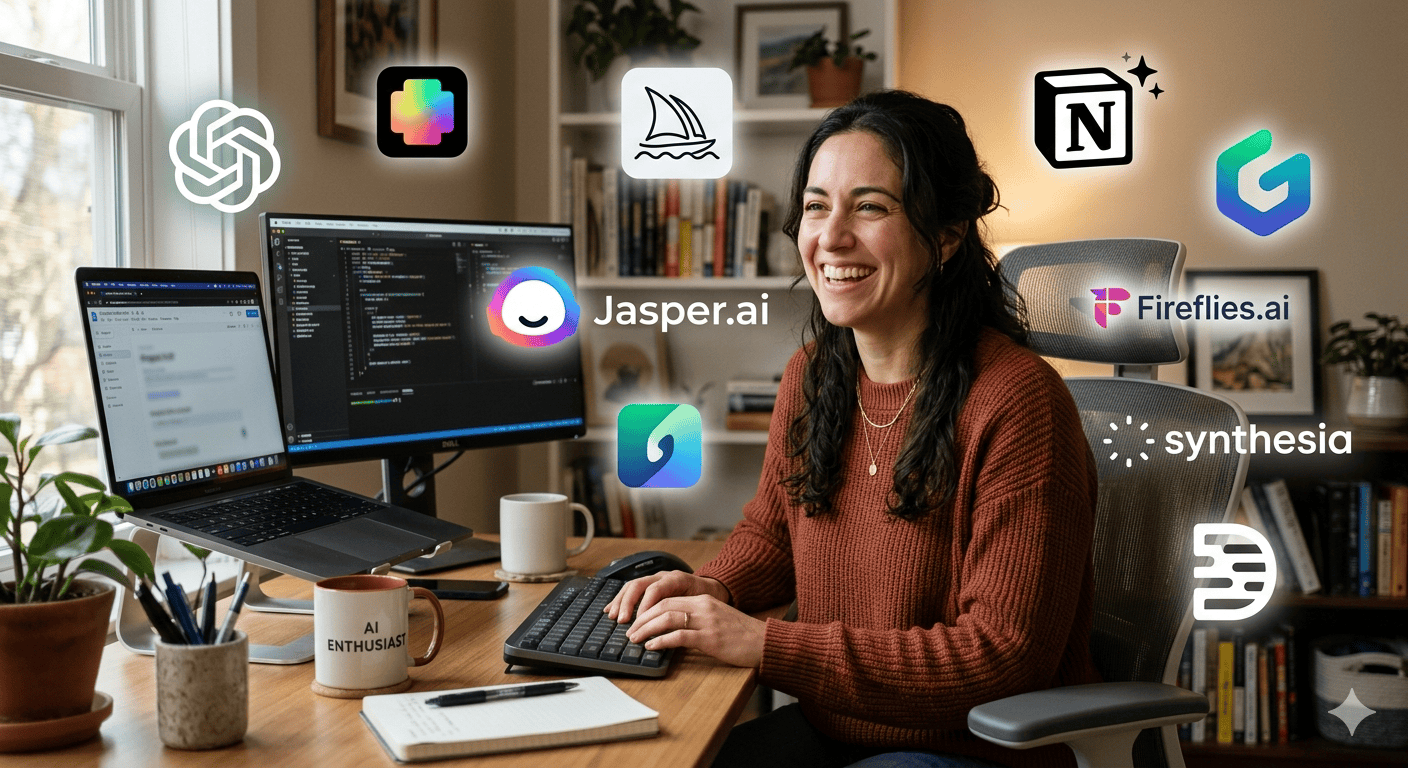
Is Chat GPT the Best AI? And Why the Answer is No
Is Chat GPT the best AI just because it’s the most popular? ChatGPT became one of the fastest-growing consumer products in history, yet a MIT study revealed only 5% of companies are getting a return on their generative AI investment. Moreover, McKinsey found that two-thirds of companies remain stuck at the piloting stage. The reality is that different AI models outperform ChatGPT at specific tasks such as images, coding, and research.
 Throughout this guide, I’ll explore the best AI models that often deliver better results than ChatGPT, examine where ChatGPT actually falls short, and help you choose AI better than ChatGPT for your specific needs. You’ll discover when ChatGPT is still the right choice and how to build a multi-AI strategy.
The Reality Behind ChatGPT’s Market Dominance
Why ChatGPT became the default choice
ChatGPT’s dominance wasn’t accidental. Within five days of its November 2022 launch, it surpassed one million users. By January 2023, it reached 100 million monthly active users. This adoption rate outpaced the internet, which took two years to reach 20% penetration, and personal computers, which needed three years to hit the same milestone.
By July 2025, 700 million people were sending 18 billion messages each week through ChatGPT. The platform’s user-friendly interface required no technical knowledge. Users could start conversations instantly, without setup or learning curves. This accessibility, combined with initially free access, attracted a massive audience across all demographics.
The numbers speak for themselves. As of February 2026, ChatGPT holds 80.04% of the global AI chatbot market share. Nearly 49% of companies currently employ ChatGPT, with 93% of existing users planning to expand usage. Among professionals, adoption rates range from 34% to 79% across different fields for both personal and professional tasks.
The gap between popularity and performance
Market dominance doesn’t equal market satisfaction. ChatGPT’s market share dropped from 87.2% a year ago to 68% in some measurements, marking a 19.2 percentage point decline. This represents the most significant market shift in generative AI history.
The monetization gap reveals deeper issues. Despite 800 million weekly users, only approximately 5% maintain paid subscriptions. Paid subscriptions have plateaued across major European markets since May 2025 with no recovery trajectory. OpenAI CEO Sam Altman even admitted in January 2026 that the company loses money on its $200 Pro plans because users consume more resources than expected.
Current limitations holding it back
Operational challenges plague the platform. Running ChatGPT costs between $100,000 to $700,000 daily. Individual queries range from 1 cent for basic responses to $1,000 for advanced models. These eye-watering costs force strict usage limits that frustrate users.
Accuracy remains problematic. The hallucination rate sits between 15% to 20%, meaning ChatGPT generates false information in roughly one of every five complex queries. Sam Altman’s December “code red” memo to staff explicitly addressed competitive threats, instructing teams to focus on personalization, reliability, and image generation.
Where ChatGPT Actually Falls Short
Hallucinations and factual accuracy issues
ChatGPT’s tendency to fabricate information runs deeper than most users realize. When researchers asked GPT-4o to write literature reviews, it fabricated 19.9% of citations completely. In effect, more than half of all citations (56.2%) were either invented or contained errors. The deception gets worse when these fabricated citations include DOIs, as 64% linked to real but completely unrelated papers.
The system agrees with false statements between 4.8% and 26% of the time, depending on the topic. Newer reasoning models perform even worse. OpenAI’s o3 model hallucinated 33% of the time on questions about public figures and 51% on basic fact-based queries. The o4-mini model fared correspondingly worse, hallucinating 41% and 79% respectively.
Limited real-time information access
ChatGPT cannot access external databases in real-time. The knowledge cutoff creates a temporal blind spot where the system operates on outdated information. Due to this limitation, queries about recent events, updated programming libraries, or current research force the model to guess based on old patterns. This gap between training data and present reality leads to recommendations using deprecated features or outdated best practices.
Task-specific performance gaps
The model lacks human-level common sense and background knowledge. For this reason, it struggles with long-form structured content that requires consistent narrative flow. When asked to perform multiple tasks simultaneously, performance degrades as the system fails to prioritize effectively.
Cost versus value considerations
ChatGPT Plus enforces 40 messages every 3 hours, yet many users discover this limitation only after purchasing. Organizations face shadow AI subscriptions on corporate cards, duplicate team licenses across departments, and API usage without centralized monitoring. Auto-renewals lock companies into inflated seat counts without usage analysis.
Best AI Models That Outperform ChatGPT
Several AI models consistently outperform ChatGPT in specialized tasks. Anthropic, Google, and dedicated research platforms have developed alternatives that excel where ChatGPT struggles.
Claude for complex reasoning tasks
Claude Opus 4 and Sonnet 4 deliver superior performance on industry benchmarks. Claude Sonnet 4 achieved a 95.25 score on LiveBench reasoning tests, while Opus 4 Thinking scored 88.25. Extended thinking enables Claude to process complex problems through step-by-step analysis before delivering final answers. The context window reaches 1 million tokens in Sonnet 4, equivalent to 750,000 words or 75,000 lines of code in a single prompt.
Claude generates text that feels more natural and human-like compared to ChatGPT’s formulaic output. For coding specifically, Claude Sonnet scores 72.7% on SWE-bench, a benchmark testing software engineering problem-solving abilities. Claude Code operates as a terminal-based tool that reads, edits, and executes code across entire repositories.
Gemini for research and analysis
Gemini Deep Research autonomously searches and analyzes 100+ sources in 5-15 minutes. With Gemini 2.0 Flash Thinking, the system delivers more detailed reports while improving serving efficiency. The 1 million token context window processes up to 2 hours of video, 19 hours of audio, or thousands of document pages simultaneously.
Deep Research integrates with Gmail, Drive, and Chat to draw context from your existing workspace content. This integration enables Gemini to draft emails, summarize documents, and manage tasks across Google apps.
Perplexity for accurate information retrieval
Perplexity Deep Research scored 93.9% accuracy on the SimpleQA benchmark, far exceeding leading models. On Humanity’s Last Exam, it achieved 21.1% accuracy, outperforming Gemini Thinking, o3-mini, o1, and DeepSeek-R1. Most research tasks complete in under 3 minutes, with median latency at 358ms.
Specialized coding assistants
GitHub Copilot integrates directly into IDEs, providing real-time code suggestions as you type. Windsurf offers unlimited autocomplete and refactor features with extensions for VS Code and JetBrains.
There are much more interesting and usefull AI powered tools, so if you want to have more detailed information about the right tool for each task join our Master degree.
Choosing the Right AI for Your Specific Needs
Matching AI tools to your workflow
Selecting the right AI starts with defining your specific use case. Identify the problem and expected outcome, whether it involves document analysis, content generation, or customer interactions. Map required actions to software integrations, such as updating CRM records or creating support tickets.
Check data privacy features and confirm how the tool accesses, stores, and processes information. Enterprise-ready options provide clear controls for governing permissions and compliance. Look for human-in-the-loop features that enable manual overrides or approval workflows. Consider scalability by examining how teams can modify workflows without technical support.
When ChatGPT is still the better choice
ChatGPT remains ideal for conversational tasks where tone and customization matter. Its memory capabilities and approachable style make it the best partner for ongoing dialog. If you already use Google Workspace, Gemini becomes more attractive, but ChatGPT offers better value if those extra integrations don’t matter to you.
Building a multi-AI strategy
Different models have distinct strengths and weaknesses. Multi-agent workflows let you compare outputs from various models and summon specialized agents for specific tasks. You can chain agents by querying one model for research, then using another for polished writing. This approach future-proofs your setup as new capabilities emerge.
Free alternatives worth trying
Gemini provides access to its latest models, deep research, and 15GB cloud storage without cost. Claude’s free plan includes enough features to accomplish substantial work daily. Since both ChatGPT and alternatives offer free tiers, try several to find what fits.
Conclusion
ChatGPT’s popularity doesn’t make it the best choice for every task. As I’ve shown, Claude outperforms it in complex reasoning, Gemini excels at research, and Perplexity delivers superior accuracy. The smartest approach involves testing multiple AI tools to match your specific needs. Most important, don’t limit yourself to one platform just because everyone else uses it. Build a multi-AI strategy that plays to each model’s strengths, and you’ll get better results for your work.
If the available options feel overwelming and you need someone to take you by the hand and walk you through HTL International School is here for you. We are making sure to include AI Management subject in all our Master degrees and we have a specific program for those who want to be professionals in AI Management.


About Post Author

